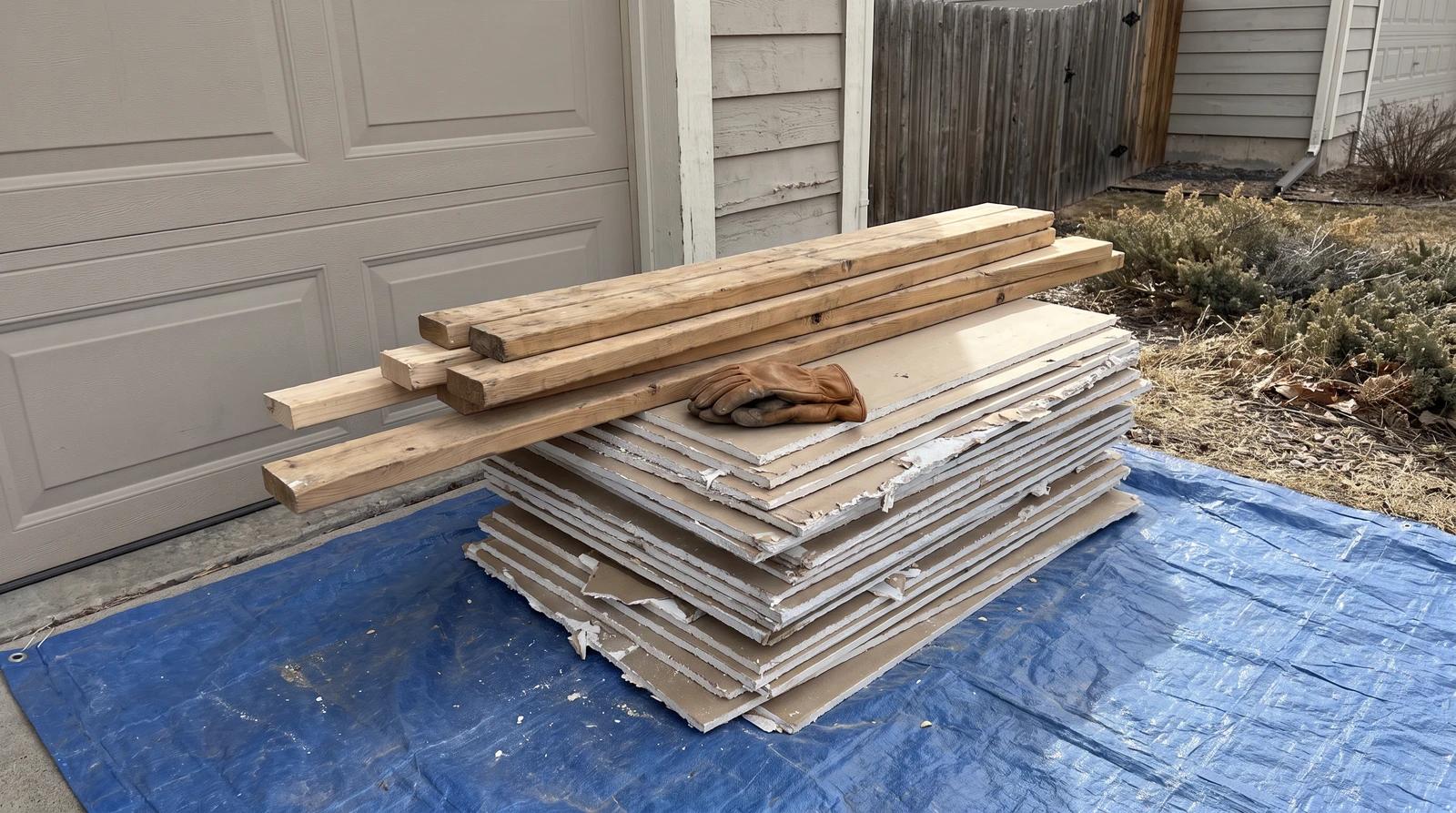
Boise Construction Debris Removal: Staging Your DIY Remodel Mess
You spent the weekend gutting the guest bathroom. The tile's off the walls, the old vanity is in pieces, and the pile of drywall chunks on the back patio seems bigger every time you look at it.
Tearing it out is one job, and getting rid of it is another. If you're planning on construction debris removal in Boise once the demo's done, the way you stage that pile has a lot to do with how fast pickup goes and what it costs.
Here's what we'd tell a friend who's doing their own remodel.
Pick the spot before the first swing
Most people figure out where the debris goes about halfway through demo, when there's already a trail of it down the hallway. Decide first.
Put it on your own property, close to where a crew can reach it, and on a hard surface if you've got one. A driveway apron or a side yard by the gate works well. If the pile is in the back corner behind a narrow gate, every armload has to be carried farther, and that's more labor.
What about the curb? Be careful there. Cities can have rules about leaving materials in the public right-of-way, and a lot of neighborhoods have HOA rules on top of that. Check with your city and your HOA before anything goes past the sidewalk.
Put a tarp down first. Drywall dust, screws and tile shards work their way into gravel and grass, and they're miserable to pick out later. Nobody wants to step on a roofing nail barefoot in July.
Sorting the pile before construction debris removal in Boise
You don't need to sort like a recycling center. A little separation still helps, because different materials end up in different places.
Clean lumber can often be reused or recycled. Concrete, brick and tile are heavy and get handled differently from the light stuff. Drywall is its own category. Metal, like old pipe, ductwork or a cast iron tub, can usually be recycled.
If everything's mixed together, somebody has to pull it apart at the drop-off or it all goes in as one load. Once it's in rough piles, more of it can be donated or recycled, and we do that whenever the material allows.
The easy version is heavy masonry on one end of the tarp and wood and drywall on the other. Set aside anything still in decent shape, like a cabinet box, a solid door or a light fixture that works. Those sometimes get a second life.
Heads up: Leftover paint, stain, solvents, adhesives and anything in an aerosol can don't belong in a debris pile. Ada and Canyon County both have household hazardous waste drop-off options, so check your county's current hours and what it accepts before those half-empty cans get mixed in with the drywall.
Treasure Valley weather changes the pile
Summers here are hot and dry. Sawdust, loose insulation and drywall dust blow around in the afternoon wind, and an uncovered pile can end up spread across your yard and your neighbor's. Cover it and weigh the tarp down.
Fall and winter bring the opposite problem. Wet drywall gets heavy and turns to mush. It falls apart in your hands, takes longer to load and adds weight. Snow can bury a pile, and debris frozen to a tarp doesn't want to let go.
If your project runs from late fall into winter, keep the pile fully covered. If it's going to sit a while, you're usually better off scheduling the haul sooner than letting it soak through a few storms.
Spring has its own crunch. Lots of Treasure Valley homeowners start projects as soon as it warms up, so schedules fill up. Give yourself some lead time.
Habits that slow pickup down
The same few things come up over and over with DIY remodel debris.
Nails left sticking out. Pulled trim and old framing are full of fasteners. Bend them over or pull them when you can. That's also safer for you while you're still working.
Bagging everything. Contractor bags are great for loose insulation and small scraps. Long boards and big drywall sheets don't fit well and tear the bags. Leave larger pieces loose and stacked flat.
Piling against the house or fence. Debris pushed up against siding holds moisture and can scuff or dent things when it's moved. Leave a gap.
Waiting for one giant pile. On a bigger project, like a full kitchen or a basement finish in Nampa or Kuna, clearing debris partway through can free up room to keep working.
What moves the price of construction debris removal in Boise
We price by how much space the debris takes up and the work involved. A tidy, sorted pile on a driveway is a simpler job than loose material scattered through a backyard, a basement and a garage.
The big factors are how much there is, how heavy it is, how far it has to be carried and where it's headed. For the same amount of space, concrete and tile weigh a lot more than wood and drywall. Stairs and tight gates add time.
Timing depends on the same things. Volume, access and the time of year matter most, and same-day service is sometimes possible depending on the schedule.
Yes, we'd love the work. But honestly, even if you end up making a few runs to the Ada County Landfill yourself, staging it this way makes the job easier no matter who does the hauling.
Before you pick up the phone
Choose your spot early, tarp it, keep the heavy stuff apart from the light stuff and cover the pile when the weather turns. That's most of it.
When you're ready, we'll come out for a free on-site estimate and give you a firm price before anything gets touched. There are no hidden fees, and we take cash, card and Venmo. Call Boise Construction Debris Removal at (208) 545-3461 whenever it works for you.
Need Construction Debris Removed?
We handle construction debris removal throughout Boise, Meridian, Nampa, and the Treasure Valley-including proper disposal and compliance with local regulations.
Call (208) 545-3461More From Our Blog
Boise Demolition Cleanup and Construction Debris Removal
Older Boise homes can hide asbestos and lead paint. Here's what to check before demolition cleanup so your construction debris removal stays simple.
Construction Debris Removal in Boise: Waste Disposal Cost
What sets construction waste disposal cost in Boise: volume, weight, access and timing. A local debris removal crew explains how a firm quote gets built.
Post-Construction Cleanup in Boise: Construction Debris Removal
Wrapping up a commercial build-out in Boise? Here's how construction debris removal fits before the final clean, the walkthrough and tenant move-in.
